

The Scales of Proof
Direct Evidence: The “Smoking Gun”
Direct evidence is proof that, if believed, directly proves a fact in issue without requiring any inference or presumption. It is “eye-witness” style evidence that speaks for itself. If a witness testifies in court, “I saw the defendant pull the trigger,” that is direct evidence of the shooting.
Examples of Direct Evidence:
- Eyewitness Testimony: A person stating exactly what they saw, heard, or felt during the commission of a crime.
- Video or Audio Recordings: High-quality security footage showing the defendant committing the act.
- Confessions: A voluntary statement by the defendant admitting to the crime.
The primary challenge with direct evidence is not its relevance, but its reliability. Human memory is fallible, and witnesses can be biased, mistaken, or untruthful. Thus, even with direct evidence, the jury must still decide whether to believe the source.
Circumstantial Evidence: The “Trail of Breadcrumbs”
Circumstantial evidence, also known as indirect evidence, is a fact or set of facts that, if proven, allow a jury to infer the existence of another fact. It does not directly prove the crime, but it creates a logical link. For example, if a witness didn’t see the shooting but saw the defendant running away from the scene holding a gun immediately after hearing a bang, that is circumstantial evidence of guilt.
Common Types of Circumstantial Evidence:
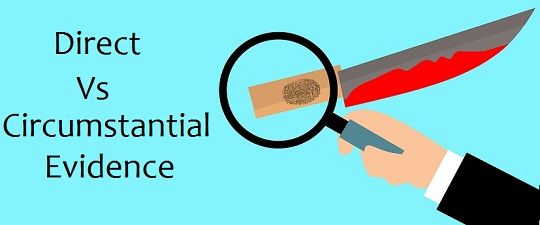
- Forensic Data: DNA found at a scene, fingerprints on a weapon, or ballistic matches.
- Digital Footprints: Cell tower pings placing a phone near a crime scene or search history showing the defendant researched “how to disable an alarm.”
- Motive and Opportunity: Evidence that the defendant had a reason to commit the crime and was in the physical position to do so.
- Behavioral Evidence: The “consciousness of guilt,” such as fleeing the jurisdiction or destroying evidence after a crime.
The Myth of Inferiority
There is a common legal misconception that a defendant cannot be convicted solely on circumstantial evidence. This is false. Under the law, both types of evidence carry equal weight. In fact, forensic circumstantial evidence—like a DNA match—is often considered more reliable than a human eyewitness, who may struggle with facial recognition under stress.
“Circumstantial evidence is like a rope. One strand may be weak, but when many strands are twisted together, they create a bond that is nearly impossible to break.”
Inferences and the Burden of Proof
The critical difference lies in the mental leap the jury must take. With direct evidence, the jury only asks: “Is this witness telling the truth?” With circumstantial evidence, the jury must ask two questions: “Is this fact true?” and “Does this fact logically lead to the conclusion that the defendant is guilty?”
To convict based on circumstantial evidence, the chain of logic must be so strong that there is no other reasonable explanation for the facts other than the defendant’s guilt. If the defense can provide a plausible, innocent explanation for the “breadcrumbs,” the prosecution has failed to meet the beyond-a-reasonable-doubt standard.
Conclusion: A Synergistic Approach
In conclusion, the most robust criminal cases rarely rely on just one form of proof. A successful prosecution typically weaves direct and circumstantial evidence together to form an undeniable narrative. While direct evidence provides the “who” and the “what,” circumstantial evidence often provides the “how,” the “why,” and the physical proof that anchors a witness’s testimony in reality.
Understanding the distinction is vital for anyone involved in the legal system, from jurors to defendants. Direct evidence may be the most dramatic, but circumstantial evidence is often the most enduring. Ultimately, the goal of the trial is to look past the labels and determine if the total sum of the evidence—be it a direct statement or a digital trail—reaches the threshold of certainty required for justice. In the modern courtroom, a well-built case of circumstantial facts is just as lethal as a smoking gun.