

Constitutional Overreach and the “State Department Absorption”
As of March 18, 2026, the United States Agency for International Development (USAID) is at the center of the most significant separation-of-powers battle in modern history. Following the Trump administration’s January 2025 executive order to freeze all foreign aid, the agency has been largely dismantled, with 83% of its programs canceled and its core functions absorbed by the U.S. State Department. However, a series of ongoing lawsuits—most notably AFSA v. Trump and Public Citizen v. Rubio—continue to challenge the legality of these moves, arguing that the President cannot unilaterally abolish an agency created by an Act of Congress.
The $2 Billion “Thaw” and Supreme Court Denial
In a major victory for humanitarian groups on March 11, 2026, the U.S. Supreme Court denied an emergency request by the administration to block a lower court order requiring the immediate payment of $2 billion in reimbursements. This funding was owed to implementing partners for work completed before the January 2025 freeze. While the administration argued that these payments infringed on executive foreign policy authority, the Court’s refusal to intervene means that USAID must now begin paying out years of back-owed funds to NGOs and contractors operating in regions like Ukraine, Ethiopia, and Bangladesh.
Despite this “financial thaw,” the broader legal question remains unresolved. Federal District Judge Amir Ali, who issued the original injunction, noted that while the President can set policy, he “is not a king” and cannot ignore the $60 billion already allocated by Congress for specific global health and development initiatives. As of March 2026, the court is reviewing whether the administration’s cancellation of over 5,200 contracts was a “rational” exercise of power or a “retaliatory” effort to purge the agency of non-aligned staff.
The USAID RIF Class Action: 2026 Status
Parallel to the funding battles is a massive employment lawsuit filed by the American Foreign Service Association (AFSA). In July 2025, a class action was initiated with the Merit Systems Protection Board (MSPB) on behalf of thousands of career Foreign Service Officers (FSOs) who were subjected to a Reduction in Force (RIF). The plaintiffs allege that the RIF was not a budget-saving measure, as claimed by Secretary of State Marco Rubio, but rather an illegal “political purge” designed to bypass civil service protections.
Key developments in the employment litigation as of March 2026 include:
- Class Certification: The MSPB is currently finalizing the class definition, which is expected to include all career FSOs separated from federal service between July and September 2025.
- “Separate and Independent” Hiring: The lawsuit challenges the State Department’s refusal to automatically transfer USAID employees, instead forcing them into a “separate and independent” hiring process that plaintiffs claim is biased against veteran development experts.
- The Inspector General Firing: On March 11, 2026, a new legal branch of the suit was opened following the retaliatory firing of the USAID Inspector General, Paul Martin. Plaintiffs argue this move was intended to shut down investigations into the “waste, fraud, and abuse” that the administration itself cited as the reason for the shutdown.
Global Health Impact and “DOGE” Influence
Public health experts are providing grim testimony in the ongoing litigation. A study published in The Lancet in late 2025 estimated that the termination of PEPFAR and other USAID-led health programs could result in over 14 million preventable deaths by 2030. In March 2026, lawyers for the plaintiffs introduced evidence suggesting that the decision to abolish USAID was heavily influenced by the Department of Government Efficiency (DOGE) and private advisors, rather than a formal inter-agency review. This evidence is being used to support the claim that the shutdown was “arbitrary and capricious” under the Administrative Procedure Act.
Compliance, Accountability, and Record Keeping
The chaos surrounding the USAID shutdown underscores the necessity of rigid compliance and transparent documentation. When billions in funding are at stake, every contract and communication must be ironclad to survive judicial review. In the private sector, integrated design and construction models provide exactly this kind of “single source of truth,” ensuring all stakeholders are protected. Furthermore, as the federal workforce undergoes these unprecedented shifts, staying informed on employment law updates for 2026 is essential for any professional navigating mass layoffs or agency reorganizations.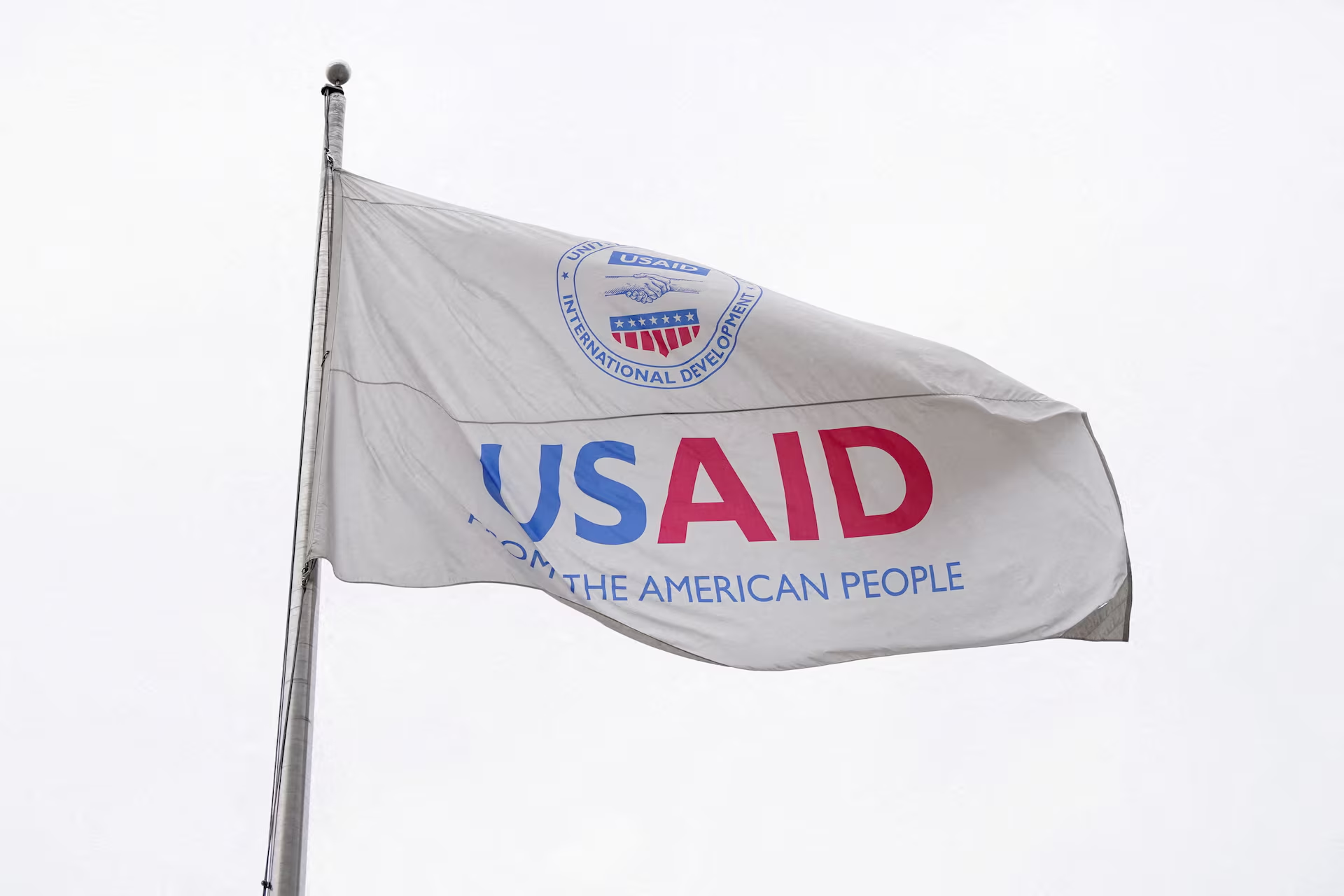
Current Status in March 2026
For now, USAID exists in a state of “legal limbo.” While the physical signage at the Ronald Reagan Building in D.C. has been removed, the agency legally remains an independent entity because Congress has not yet passed a bill to abolish it. The State Department has taken de facto control over the remaining 1,000 projects, but the courts may yet force a restoration of the original agency structure.
Key Milestones to Follow:
- The “Martin Rule” Ruling: Expected in mid-2026, this decision will determine if the President has the authority to fire Inspectors General without “detailed reasons” as required by law.
- Preliminary Injunction Hearing: Judge Ali is scheduled to hear arguments on whether to force a “total thaw” of the current aid freeze, which could restore thousands of canceled contracts.
- FY2026 Budget Fight: Congress recently passed a bill allocating $50 billion for foreign aid—a direct challenge to the administration’s $8 billion proposal—setting up a constitutional showdown over who controls the “power of the purse.”